19 Jan 2015

January + February 2015


Monday 26 January 2015 @ 7:30 pm
Canadian Archaeology in Greece
Dr. David Rupp, Canadian Institute in Greece

Dr. David Rupp, President of the Canadian Institute in Greece and Professor Emeritus, Brock University, will speak on the history and work of the Canadian Institute in Greece (formerly the Canadian Archaeological Institute at Athens). While the work of the Institute principally involves archaeological excavations from Lesbos to Euboea and from Thrace to Boeotia it also supports surveys varying from Carpathos to Crete to the Argolid. It also has a cultural role in Athens sponsoring exhibitions, concerts, films and other activities and supports the work of Canadian scholars and students in any area concerning Greece.


Monday 23 February 2015 @ 7:30 pm
Ancient Judaism and Hellenism
Dr. Gregg E. Gardner
UBC Diamond Chair in Jewish Law and Ethics

Judaism and Hellenism have often been pitted against each other as irreconcilable opposites. No historical epoch epitomizes this more than the revolt of the Jewish Maccabees against Hellenistic rule in the Second Century B.C.E. – a series of events that has marked ever since by the holiday of Hannukah. But did the ancient Jews simply reject Hellenism or did they take a more nuanced and sophisticated approach to Greek culture? Professor Gardner will explore Judaism’s complex relationship with Hellenism by examining ancient texts (in English translation) and archaeological finds.

9 Oct 2014

October + November 2014


Monday 27 October 2014 at 7:30 pm
Settling the West:  Comparing Ancient Greek and New World Frontiers
Professor Franco De Angelis, UBC

Europe’s exploration and settlement of (to them) the New World in the 16th to 20th centuries of our era resulted in a significant expansion of human experiences with which Europeans could understand their past and imagine their futures.  Ancient Greece and Rome served as a major source of inspiration in these respects because of their importance to European education and identity.  Thus a two-way dialogue emerged, one in which Europeans regularly made parallels between their exploration and settlement of the New World with understanding ancient Greek and Roman history and, vice versa, the role ancient Greece and Rome played in providing parallels with imagining how life in the New World might one day become.  This illustrated talk will investigate both these kinds of parallels and the motivations for them, especially those derived from ancient Greece, as well as assessing the distortions and possibilities raised by such parallels.


Monday 24 November 2014
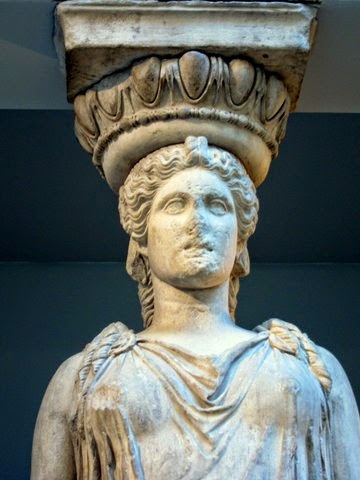
The Maidens of the Erechtheion
Dr. Alexandra Lesk
 
This lecture will focus on the Porch of the Maidens - the most famous feature of the Temple of Athena Polias - the Erechtheion. Each maiden’s unique story will be told against the backdrop of the changes experienced by the Erechtheion as a whole from the fifth century BC to the present. Each maiden has a different story to tell, from the one Lord Elgin’s agents removed to London and replaced with a brick pillar to the maiden who was smashed to smithereens by Venetian cannon fire. These ladies took on different symbolic meanings throughout the ages: submission under the Romans, purity under the Byzantines, ill-gotten booty under the Ottomans, and soulful sisters featuring in ghost stories of the Grand Tourists of the 19th C. Thanks to their constant visibility on the Acropolis, and being featured in the copy-books of neoclassical architects, the maidens of the Erechtheion have been a part of the psyche of the West for two and a half millennia and continue to inspire artists and architects today